Are These Common Oversights Cutting Short Your Smart Appliance's Lifespan?
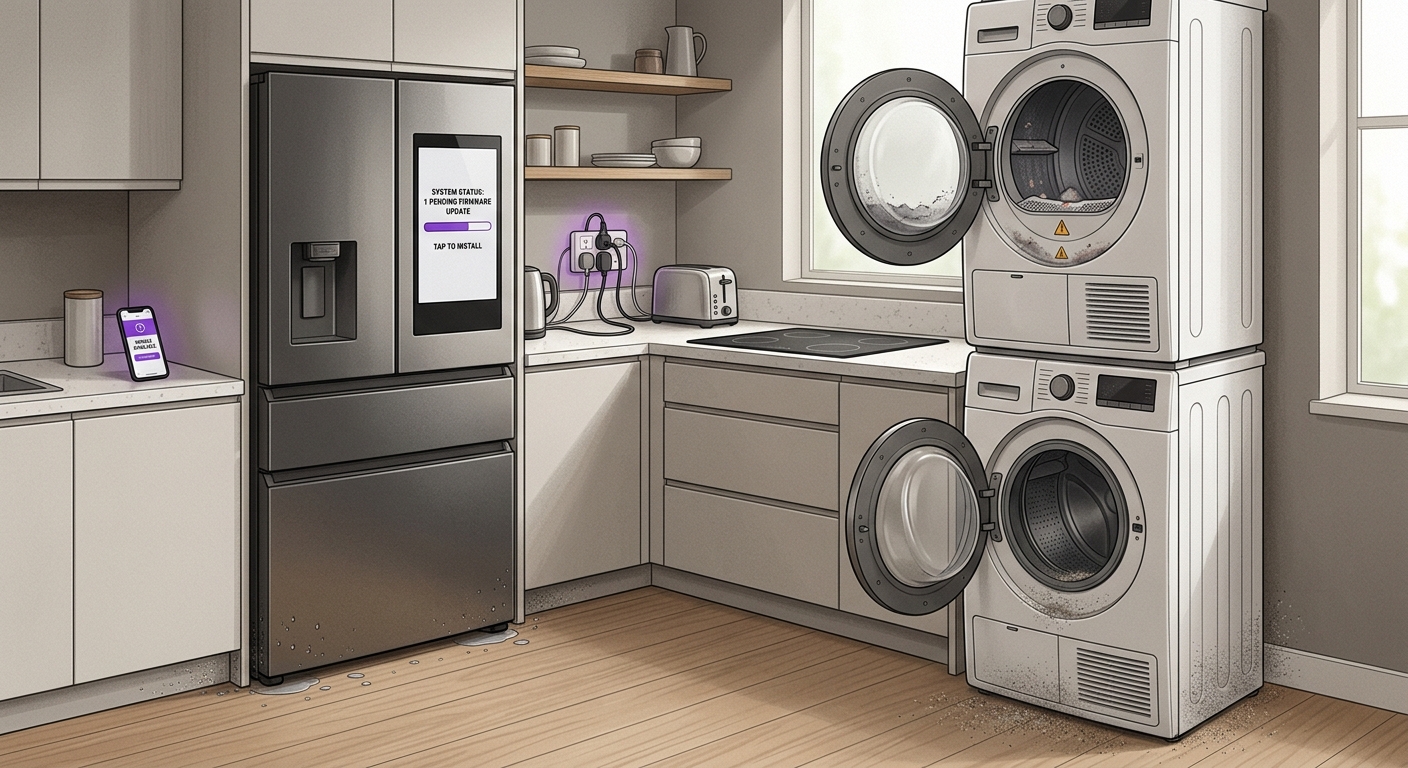
Could a smart appliance be wearing itself out because of something you barely notice? Smart appliance longevity is not determined only by the quality of a motor, compressor, pump, heating element, or circuit board. Everyday conditions such as restricted airflow, accumulated residue, persistent humidity, overloaded cycles, unstable placement, neglected seals, and ignored software maintenance can all change how hard an appliance has to work.
The useful distinction is between normal wear and avoidable stress. A washing machine will eventually experience bearing or pump wear. A refrigerator will eventually age. A connected oven may eventually need electronic repair. But an appliance that runs hot because its airflow path is clogged, stays damp because a leak is ignored, or loses software support because updates are repeatedly dismissed may be exposed to avoidable problems long before its underlying components have reached their natural service limits.
Is smart appliance longevity really affected by ordinary housekeeping?
Short answer: yes, but not in the simplistic way people sometimes assume. Housekeeping does not magically make an appliance immortal. Instead, routine care reduces several forms of stress that can accelerate wear: excess heat, poor airflow, moisture exposure, residue buildup, mechanical imbalance, and blocked drainage.
That matters because a smart appliance is usually two systems working together. The physical machine still has pumps, fans, motors, valves, heaters, compressors, bearings, seals, ducts, and moving parts. The connected layer adds sensors, control boards, wireless communications, firmware, apps, and sometimes cloud-dependent functions. A problem in either layer can affect the overall experience.
A useful way to think about maintenance is therefore not “clean everything constantly,” but “remove avoidable stress before it becomes a failure.” If an appliance manual says a filter should be cleaned every few uses, follow that schedule. If the manufacturer specifies a clearance around a refrigerator or heat-producing appliance, preserve it. If a drain path is designed to remain unobstructed, do not treat slow drainage as a harmless inconvenience.
Why do small oversights create bigger appliance problems?
Many appliance failures are cumulative. A single dusty vent may not cause an immediate fault. A single overloaded laundry cycle may not damage a machine. A few hours of elevated humidity may not destroy electronics. The concern is repeated exposure.
Heat is one example. When airflow is restricted, heat produced during operation may not leave the appliance as efficiently as intended. The result is not automatically a shortened lifespan, because appliance designs differ and their control systems may compensate. But persistent thermal stress is a sensible reason to keep vents, filters, heat-exchange surfaces, and surrounding clearances clean and unobstructed.
Moisture is another. The U.S. Environmental Protection Agency recommends controlling indoor moisture and keeping relative humidity below 60 percent, ideally around 30 to 50 percent, while promptly addressing condensation and water intrusion. That guidance is primarily about indoor environmental quality rather than appliance service life, but the underlying environmental lesson is relevant: persistent moisture should be treated as a condition to correct, not merely a surface to wipe dry.
Electronics deserve particular attention. Professional engineering guidance notes that high relative humidity can contribute to condensation in electronic equipment, while low humidity can increase static-electricity concerns. That does not mean every household should chase a precise humidity number for every smart appliance. Manufacturer specifications remain the controlling source for a particular device. The practical point is to avoid extreme or rapidly changing conditions when the appliance is installed in a damp, poorly ventilated, or otherwise unsuitable location.
Which “maintenance shortcuts” are actually false economies?
One common misconception is that maintenance matters only when an appliance looks dirty. In reality, some of the most consequential maintenance tasks concern components that are hidden or easy to overlook.
- Ignoring airflow: A lint screen, vent, grille, filter, or heat-transfer surface can restrict performance even when the visible exterior looks clean.
- Waiting for a failure code: A smart diagnostic system can be useful, but an error code is not a substitute for routine care. The appliance may detect a problem only after operating conditions have already deteriorated.
- Assuming “smart” means self-maintaining: Sensors can detect conditions, but they cannot physically remove lint, clean a filter, repair a seal, or clear a blocked drain unless the appliance was specifically designed to do so.
- Skipping software updates: Updates are primarily a security and functionality issue rather than a mechanical-maintenance task, but connected appliances remain part of a broader device lifecycle. NIST research has documented user confusion about whether smart-home updates have actually been applied.
- Using generic cleaning methods: More cleaning is not always better. A harsh chemical, excessive water, abrasive tool, or aggressive disassembly can create a new problem.
What does a real appliance-maintenance routine look like?
A useful routine is layered. The easiest tasks should happen frequently, while deeper inspection should happen according to the manufacturer's instructions, observed symptoms, and the type of appliance.
The table also illustrates an important limitation: these are risk relationships, not guarantees. A clean filter does not prove that a motor will last longer, and a neglected filter does not prove that a motor will fail. The purpose of preventive care is to reduce avoidable stress and preserve intended operating conditions.
Could the installation environment be the hidden culprit?
Sometimes the appliance is not the real problem. Its surroundings are.
Consider a refrigerator installed so tightly against a wall that its specified ventilation space is compromised. The refrigerator may continue cooling, so the owner assumes everything is fine. But if the design depends on releasing heat through a particular area, restricting that path changes the operating environment. The correct response is not automatically to buy a new refrigerator; first verify the manufacturer's installation requirements and restore the specified clearance if it is missing.
Now consider a laundry appliance in a humid room where condensation repeatedly forms around cold surfaces. If the humidity remains high, cleaning the visible moisture without addressing ventilation or the source of moisture is a temporary response. EPA guidance emphasizes controlling the source of moisture, reducing excessive humidity, and drying damp areas promptly.
There is also a counterexample worth remembering: lower humidity is not automatically better. Very dry conditions can contribute to static-electricity concerns for electronics, while rapid humidity changes can also be undesirable. The sensible rule is conditional: if the space is persistently damp or condensation is visible, investigate moisture control; if it is already within the appliance manufacturer's specified environmental range, do not introduce aggressive dehumidification merely because “drier must be safer.”
What can dryer maintenance teach us about appliance longevity?
Dryers provide one of the clearest examples because airflow is central to their operation. U.S. safety guidance recommends cleaning the lint filter before or after each use, keeping the exhaust path unrestricted, and checking the vent system when drying takes longer than normal.
The broader lesson applies beyond dryers. A smart appliance may have a sophisticated display, remote notifications, and automatic diagnostics, but its physical requirements have not disappeared. If a machine needs airflow, drainage, cooling, filtration, or a clean sensor surface, the connected interface cannot compensate indefinitely for a neglected physical system.
This is also where a maintenance kit can be useful as a concept rather than a shopping objective. A household may need a soft brush, appropriate cloths, a vacuum attachment, a lint-removal tool, or a replacement filter depending on the appliance. The correct item is the one compatible with the manufacturer's maintenance procedure. More tools are not inherently better.
Does replacing a part always make more sense than replacing the appliance?
No. This is one of the most important exceptions.
Repair can extend useful life, and research on household appliances has found recurring failure categories in washing machines and dishwashers, including electronics, pumps, bearings, valves, doors, and other components. But a repair decision depends on the actual fault, parts availability, labor, safety, age, remaining service potential, and whether other major components are also deteriorating.
Use conditional logic instead of a blanket rule:
- If the problem is a clearly identified, accessible, serviceable component and the appliance otherwise operates normally, a targeted repair may be sensible.
- If the appliance has multiple unrelated faults, significant structural damage, or a safety-critical failure, professional assessment becomes more important before attempting any repair.
- If the issue is only a clogged filter, blocked drain, dirty sensor area, or similar maintenance condition, correct the maintenance issue before assuming a major component has failed.
- If the device has lost essential software support while the physical hardware remains sound, investigate what functions actually depend on the connected service before deciding that the entire appliance is obsolete.
The point is not to keep every appliance running forever. Responsible longevity means making a reasoned distinction between preventable neglect, economical repair, normal aging, and a genuinely end-of-life condition.
What about standby power and always-connected appliances?
Connected appliances can consume electricity while they appear inactive. The Department of Energy describes standby power as consumption that occurs when a device is in a low-power state rather than performing its primary function.
It is tempting to conclude that standby power itself is a major cause of shortened physical lifespan. That conclusion is too broad. Background electrical consumption is primarily an energy-use issue, while physical longevity depends on the design, thermal conditions, cycling, component quality, environment, and maintenance history. An appliance that remains connected to a network is not automatically “wearing out” merely because its communication circuitry is awake.
The more useful application is diagnostic. If an appliance suddenly changes its normal energy behavior, cycles unusually often, runs when it should be idle, or repeatedly wakes because of a fault, that may justify investigation. A plug-in energy meter can sometimes help observe household electrical behavior on compatible appliances, but it cannot diagnose every internal failure.
Are software updates really part of appliance maintenance?
For a connected appliance, yes—but with an important qualification. Software updates should not be treated as if they clean a pump or lubricate a bearing. They address a different layer of the product.
NIST identifies cybersecurity capabilities relevant to consumer IoT products, and its research on smart-home updates found that users can have difficulty understanding whether updates have been applied and why they matter. More recent NIST guidance also emphasizes lifecycle communication involving cybersecurity, maintenance, support, and end-of-life.
That means an owner should periodically check three things: whether the appliance firmware is current, whether the companion app is current, and whether the manufacturer still supports the device. If updates are optional, read the release information when practical. If an update fails repeatedly, treat that as a troubleshooting issue rather than repeatedly pressing the update button without understanding the cause.
Misconception correction: keeping firmware current is not a promise that the physical appliance will last longer. It is better described as preserving the supported condition of the connected layer, reducing known security exposure, and helping maintain intended functionality.
Can diagnostic tools prevent premature replacement?
They can sometimes prevent a wrong diagnosis, which is valuable. A diagnostic screen, fault history, energy monitor, temperature reading, or manufacturer service mode may reveal whether the observed symptom is consistent with a blocked path, sensor problem, drainage issue, or another condition.
But diagnostics have limits. A fault code is usually an indicator, not a complete repair instruction. Two different physical problems can produce related symptoms, and some intermittent failures may leave little useful evidence. A diagnostic tool should therefore support reasoning rather than replace it.
If the appliance reports a temperature, airflow, water-level, or door-seal problem, begin with the safe user-serviceable checks listed by the manufacturer. If the symptom persists, move toward professional diagnosis rather than escalating from a basic cleaning task to invasive electrical work.
Which signs should make you stop treating a problem as “routine maintenance”?
Some symptoms change the decision completely. Routine cleaning is appropriate for routine maintenance conditions; it is not a universal response to electrical, mechanical, gas, refrigerant, or water-related hazards.
- Repeated breaker or safety-device trips.
- Burning or melting smells.
- Visible arcing, damaged wiring, or a damaged power cord.
- Water entering an electrical compartment.
- Gas odor or suspected combustion problems.
- Unusual grinding, severe vibration, or rapidly worsening mechanical noise.
- Repeated fault codes after the manufacturer's basic troubleshooting steps.
- Evidence of overheating that returns after a safe cleaning and airflow check.
If any of these conditions appear, the goal shifts from maximizing convenience to controlling risk. Disconnecting power may be appropriate when it can be done safely, but appliance-specific safety instructions should take priority.
What should you actually do this week?
A short checklist is more useful than an unrealistic promise to “deep clean everything.” Work through the tasks that apply to your appliances and stop when a task moves beyond safe owner maintenance.
- Check each smart appliance for visible dust, blocked grilles, or restricted airflow.
- Clean user-serviceable filters and lint traps on the schedule specified by the manufacturer.
- Inspect accessible drain areas for obvious debris or slow drainage.
- Look around appliances for condensation, water stains, damp flooring, or recurring leaks.
- If the room is persistently humid, measure humidity instead of guessing.
- Confirm that refrigerators, dryers, ovens, and other heat-producing appliances have the required installation clearance.
- Check door seals and gaskets for visible damage, distortion, or residue.
- Review unusual noises, vibration, longer cycles, or repeated error messages rather than normalizing them.
- Check firmware and companion-app update status for connected appliances.
- Record the model number, serial information, and recurring symptoms before contacting service.
- Use replacement parts only when they match the appliance's specified part or approved service procedure.
- Stop and seek qualified service when the problem involves unsafe electrical, gas, refrigerant, or concealed mechanical work.
Frequently asked questions about smart appliance longevity
1. Does cleaning an appliance really make it last longer?
It can reduce avoidable stress, but it does not guarantee a longer service life. Cleaning is most valuable when it restores an intended operating condition such as airflow, drainage, filtration, or a clean sensor surface. It cannot prevent normal aging of every component.
2. Is high humidity bad for every smart appliance?
Not necessarily. Appliance environmental specifications differ. High humidity and condensation can create unfavorable conditions for electronics and building materials, but the appropriate range should come from the appliance manufacturer. If condensation is repeatedly visible, address the moisture source rather than assuming the appliance is simply defective.
3. Should I unplug a smart appliance when I am not using it?
Not automatically. Some appliances need continuous power for monitoring, scheduling, protection, or connected functions. Unplugging can also reset clocks, settings, or connectivity. Consider the manufacturer's instructions and the actual standby-energy behavior rather than applying a universal rule.
4. Can a smart diagnostic tool tell me exactly what failed?
Usually not. Diagnostics can narrow possibilities and reveal fault conditions, but they are not always definitive. Treat a code or sensor reading as evidence that needs context. If the recommended user checks do not resolve the problem, professional diagnosis may be appropriate.
5. Are replacement parts always better than buying another appliance?
No. A replacement part can be sensible when the failure is isolated and the appliance has substantial useful life remaining. It becomes less straightforward when several major components are failing, repair costs are disproportionate, safety is involved, or manufacturer support is ending.
6. Does updating firmware improve physical appliance lifespan?
Not directly. Firmware updates mainly maintain the connected software layer, address security issues, and sometimes correct functionality. They should be viewed as part of connected-device lifecycle maintenance rather than as a mechanical repair.
7. What is the biggest maintenance mistake people make?
There is no single universal mistake. The most consequential oversight depends on the appliance. For a dryer, restricted lint airflow is especially important. For a refrigerator, installation clearance and heat rejection matter. For a washing machine, loading, drainage, vibration, and serviceable filters can matter. For any connected appliance, ignoring both physical symptoms and software support creates two separate maintenance blind spots.
8. When should I stop troubleshooting and call a professional?
Stop when the issue involves hazards, concealed components, specialized systems, repeated failures after safe manufacturer-directed checks, or work you are not trained to perform. The purpose of preventive maintenance is to reduce risk, not to turn every homeowner into an appliance technician.
What is the practical takeaway?
The strongest approach to smart appliance longevity is not obsessive cleaning or replacing parts at the first sign of trouble. It is disciplined attention to the conditions the appliance was designed to operate under.
Keep airflow paths clear when the design depends on them. Control persistent moisture rather than repeatedly cleaning its visible effects. Respect load limits and installation clearances. Treat strange noises, leaks, overheating, slow cycles, and recurring fault codes as information rather than background noise. Keep connected software supported when updates are available. And when a problem crosses into electrical, gas, refrigerant, sealed-system, or other specialized territory, recognize that the right maintenance decision may be to stop and obtain qualified service.
Research on appliance failures reinforces why this balanced approach matters: real-world failures occur across electronics, pumps, bearings, valves, doors, and other components, so there is no single maintenance trick that guarantees longevity. The useful goal is narrower and more achievable—remove the preventable stresses, recognize symptoms earlier, preserve the conditions the manufacturer specifies, and make repair-versus-replacement decisions from evidence rather than habit.
In other words, the question is not whether your smart appliance can last forever. It is whether today's small, fixable oversight needs to become tomorrow's expensive failure. In many homes, the answer starts with something much less sophisticated than the appliance itself: clear airflow, controlled moisture, sensible loading, timely maintenance, and attention to what the machine is already trying to tell you.


Comments
Post a Comment